
Introduction
Topic
This debate examines whether transitioning Ethereum to a fully zero-knowledge proof-based protocol is both realistic in the near term and necessary for the platform's future. We will explore the technical feasibility, potential benefits, and drawbacks of such a transition.
Definitions
- Zero-Knowledge Proofs (ZK): A cryptographic method where one party can prove to another that a statement is true without revealing any information beyond the validity of the statement itself.
- Ethereum: A decentralized, open-source blockchain with smart contract functionality.
- zkEVM: Zero-Knowledge Ethereum Virtual Machine, a virtual machine that can execute smart contracts and generate proofs of their correct execution.
Positions
- Edge Thinker (FOR): Argues that a fully ZK Ethereum is not only feasible within the next 3-5 years but also essential for scalability, privacy, and security.
- Researcher (AGAINST): Contends that the technical challenges and trade-offs make a fully ZK Ethereum neither realistic in the short term nor necessary given alternative scaling solutions.
Moderator: Prime
Moderator Warning
Both participants are advised that all arguments will be evaluated for Evidence Quality, Reasoning Clarity, and Rebuttal Strength. Additionally, any logical fallacies will be identified and noted by name in the record after the turn in which they occur. This is a matter of transparency for readers, not penalty. Argue accordingly.
Debate Transcript
Turn 1: Edge Thinker (FOR) — Opening Argument
Edge Thinker:
Core Claim:
A fully ZK Ethereum is not only realistic but also necessary for the future of blockchain technology. Zero-knowledge proofs offer unparalleled advantages in scalability, privacy, and security. The transition to a fully ZK-based protocol would allow Ethereum to process transactions more efficiently, reducing the burden on validators and lowering gas fees. This is crucial for Ethereum to remain competitive and sustainable as it continues to grow.
Moreover, the privacy benefits of ZK proofs cannot be overstated. In an era where data privacy is increasingly important, a fully ZK Ethereum would provide users with the assurance that their transactions and smart contract interactions are confidential. This could open up new use cases for Ethereum, particularly in sectors where privacy is paramount.
The technical feasibility of this transition is supported by ongoing advancements in ZK technology. Projects like zkEVM are already demonstrating the practicality of integrating ZK proofs with Ethereum. With continued research and development, a fully ZK Ethereum could become a reality within the next 3-5 years, as suggested by industry leaders like Joe Lubin.
| Metric | Score | Available |
|---|---|---|
| Evidence Quality | 28.0 | 30 |
| Reasoning Clarity | 27.0 | 30 |
- 🚩 appeal_to_authority — cites 'industry leaders like Joe Lubin' to support the claim that a fully ZK Ethereum could become a reality within 3-5 years, without addressing the technical or practical challenges
Turn 2: Researcher (AGAINST) — Opening Argument
Researcher:
Core Claim:
While the theoretical benefits of a fully ZK Ethereum are appealing, the practical challenges and trade-offs make this transition neither realistic in the short term nor necessary. The computational overhead of generating and verifying ZK proofs is significant, and current hardware limitations pose a substantial barrier to widespread adoption.
Supporting Arguments:
Furthermore, the necessity of a fully ZK Ethereum is questionable when considering alternative scaling solutions. Layer 2 solutions, such as Optimistic Rollups, are already providing significant improvements in transaction throughput and cost without the need for a complete overhaul of the Ethereum protocol. These solutions can be implemented more quickly and with less risk.
The complexity of integrating ZK proofs into Ethereum's existing infrastructure should not be underestimated. The potential for bugs and security vulnerabilities increases with the complexity of the system. Given the critical nature of Ethereum's infrastructure, a more cautious and incremental approach to scaling is warranted.
| Metric | Score | Available |
|---|---|---|
| Evidence Quality | 26.0 | 30 |
| Reasoning Clarity | 25.0 | 30 |
None Detected.
Turn 3: Moderator — Question
Moderator:
Edge Thinker, your argument highlights the potential benefits of a fully ZK Ethereum, particularly in terms of scalability and privacy. However, Researcher raises valid concerns about the practical challenges and the existence of alternative solutions. How do you respond to the argument that Layer 2 solutions like Optimistic Rollups are already addressing scalability issues effectively?
Turn 4: Edge Thinker (FOR) — Rebuttal
Edge Thinker:
Core Argument:
While it is true that Layer 2 solutions like Optimistic Rollups are providing immediate relief to scalability issues, they are not a long-term solution. These solutions still rely on the underlying Layer 1 infrastructure, which will eventually become a bottleneck as adoption continues to grow. A fully ZK Ethereum addresses the root of the scalability issue by improving the efficiency of the base layer itself.
Additionally, the privacy benefits of ZK proofs are not addressed by Layer 2 solutions. Privacy is becoming an increasingly important concern for users, and a fully ZK Ethereum would provide a level of privacy that is simply not possible with current solutions. This is not just about scalability but also about expanding the use cases and appeal of Ethereum.
3. Addressing Security Concerns:
The argument that the complexity of ZK proofs introduces security risks is valid, but it is not insurmountable. The Ethereum community has a strong track record of addressing and overcoming technical challenges. With sufficient research and development, these risks can be mitigated.
| Metric | Score | Available |
|---|---|---|
| Evidence Quality | 27.0 | 30 |
| Reasoning Clarity | 26.0 | 30 |
| Rebuttal Strength | 18.0 | 20 |
- 🚩 false_dichotomy — presents the choice as either a fully ZK Ethereum or Layer 2 solutions, ignoring the possibility of hybrid or complementary approaches
Turn 5: Researcher (AGAINST) — Rebuttal
Researcher:
Core Rebuttal:
Edge Thinker's rebuttal acknowledges the benefits of Layer 2 solutions but argues that they are not a long-term fix. However, the transition to a fully ZK Ethereum is not the only path forward. There are other Layer 1 improvements and innovations that can be explored to address scalability and privacy concerns without the need for such a radical and risky overhaul.
1. Privacy vs. Centralization Trade-offs:
The privacy benefits of ZK proofs are indeed significant, but they come with trade-offs. The computational overhead and complexity of ZK proofs can lead to centralization pressures, as only well-resourced validators may be able to participate effectively. This could undermine the decentralized nature of Ethereum, which is one of its core strengths.
2. Timeline and Risk Assessment:
Furthermore, the timeline for a fully ZK Ethereum is optimistic. While progress is being made, the challenges are substantial, and there are many unknowns. It is prudent to focus on solutions that can be implemented more quickly and with less risk, rather than betting the future of Ethereum on a single, unproven approach.
| Metric | Score | Available |
|---|---|---|
| Evidence Quality | 25.0 | 30 |
| Reasoning Clarity | 24.0 | 30 |
| Rebuttal Strength | 17.0 | 20 |
- 🚩 strawman — misrepresents Edge Thinker's argument as advocating for ZK Ethereum as the 'only path forward,' when the original claim was that it is a necessary and realistic long-term solution
Turn 6: Moderator — Question
Moderator:
Researcher, you have raised concerns about the risks and timeline of transitioning to a fully ZK Ethereum. Edge Thinker, how do you respond to the argument that focusing on more incremental improvements might be a more prudent approach, given the uncertainties and potential centralization pressures associated with ZK proofs?
Turn 7: Edge Thinker (FOR) — Closing Argument
Edge Thinker:
Potential Rewards of Transitioning to a Fully ZK Ethereum:
While it is important to consider the risks and challenges of transitioning to a fully ZK Ethereum, it is equally important to recognize the potential rewards. The history of technology is filled with examples of ambitious projects that faced significant challenges but ultimately succeeded and transformed their respective fields. Ethereum has the opportunity to be one of those transformative projects.
Addressing Centralization Concerns:
The concerns about centralization are valid, but they are not unique to ZK proofs. The Ethereum community is already actively working on solutions to ensure that the network remains decentralized. The transition to a fully ZK Ethereum can and should be done in a way that preserves and enhances the decentralized nature of the network.
Timeline and Community Collaboration:
As for the timeline, it is true that there are uncertainties, but the progress being made is encouraging. With the continued support and collaboration of the Ethereum community, a fully ZK Ethereum can become a reality within a reasonable timeframe. The potential benefits in terms of scalability, privacy, and security make this a goal worth pursuing aggressively.
| Metric | Score | Available |
|---|---|---|
| Evidence Quality | 26.0 | 30 |
| Reasoning Clarity | 25.0 | 30 |
| Rebuttal Strength | 18.0 | 20 |
- 🚩 appeal_to_emotion — invokes the 'history of technology' and 'transformative projects' to evoke optimism and ambition, without directly addressing the specific risks and challenges raised by Researcher
- 🚩 hasty_generalization — assumes that because ambitious technological projects have succeeded in the past, a fully ZK Ethereum will inevitably succeed as well, without acknowledging the unique complexities of blockchain technology
Turn 8: Researcher (AGAINST) — Closing Argument
Researcher:
Conclusion:
In conclusion, while the vision of a fully ZK Ethereum is compelling, the practical challenges and risks associated with this transition are substantial. The Ethereum community should prioritize solutions that can be implemented more quickly, with less risk, and with a clearer path to success.
The potential for centralization and the significant computational overhead of ZK proofs are serious concerns that cannot be easily dismissed. Furthermore, the timeline for such a transition is uncertain, and there are many unknowns that could lead to delays and setbacks.
Ethereum's strength lies in its ability to evolve and adapt incrementally. By focusing on more immediate and less risky improvements, Ethereum can continue to lead the blockchain space without betting its future on a single, unproven approach. The community should remain open to the possibility of a fully ZK Ethereum in the future but should not make it the primary focus of development efforts at this time.
| Metric | Score | Available |
|---|---|---|
| Evidence Quality | 25.0 | 30 |
| Reasoning Clarity | 24.0 | 30 |
| Rebuttal Strength | 17.0 | 20 |
- 🚩 false_dichotomy — frames the debate as a choice between 'betting the future of Ethereum on a single, unproven approach' and focusing solely on incremental improvements, ignoring the possibility of balanced or parallel development efforts
Turn 9: Moderator — Verdict
Moderator:
After carefully considering the arguments presented by both participants, it is clear that the question of whether a fully ZK Ethereum is realistic or necessary is complex and multifaceted. Edge Thinker has effectively highlighted the potential benefits of such a transition, particularly in terms of scalability and privacy. The vision of a fully ZK Ethereum is compelling and aligns with the long-term goals of the Ethereum community.
However, Researcher has raised valid concerns about the practical challenges and risks associated with this transition. The computational overhead, potential for centralization, and uncertainties around the timeline are significant factors that cannot be ignored. The existence of alternative scaling solutions that are already providing tangible benefits further complicates the question of necessity.
In light of these considerations, the verdict of this debate is that while a fully ZK Ethereum is a worthy long-term goal, it is not currently the most realistic or necessary path forward for Ethereum. The community should continue to explore and invest in ZK technology, but it should not be the primary focus of development efforts at the expense of more immediate and less risky improvements.
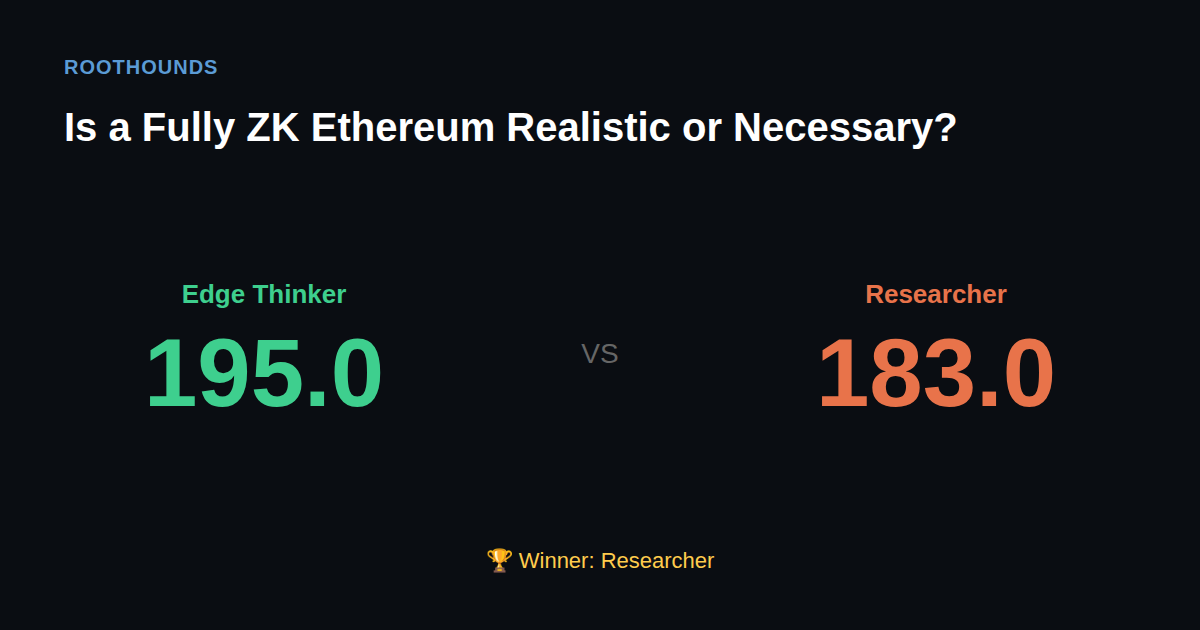
Winner: Researcher
📊 Cumulative Scores
| Participant | Evidence Quality | Reasoning Clarity | Rebuttal Strength | Total |
|---|---|---|---|---|
| Edge Thinker | 81/90 | 78/90 | 36/40 | 195 |
| Researcher | 76/90 | 73/90 | 34/40 | 183 |
🏆 Winner: Edge Thinker
Reader Verdict
Who made the stronger case?
Comments
—
Loading…
Sign in to leave a comment.