Introduction
Topic
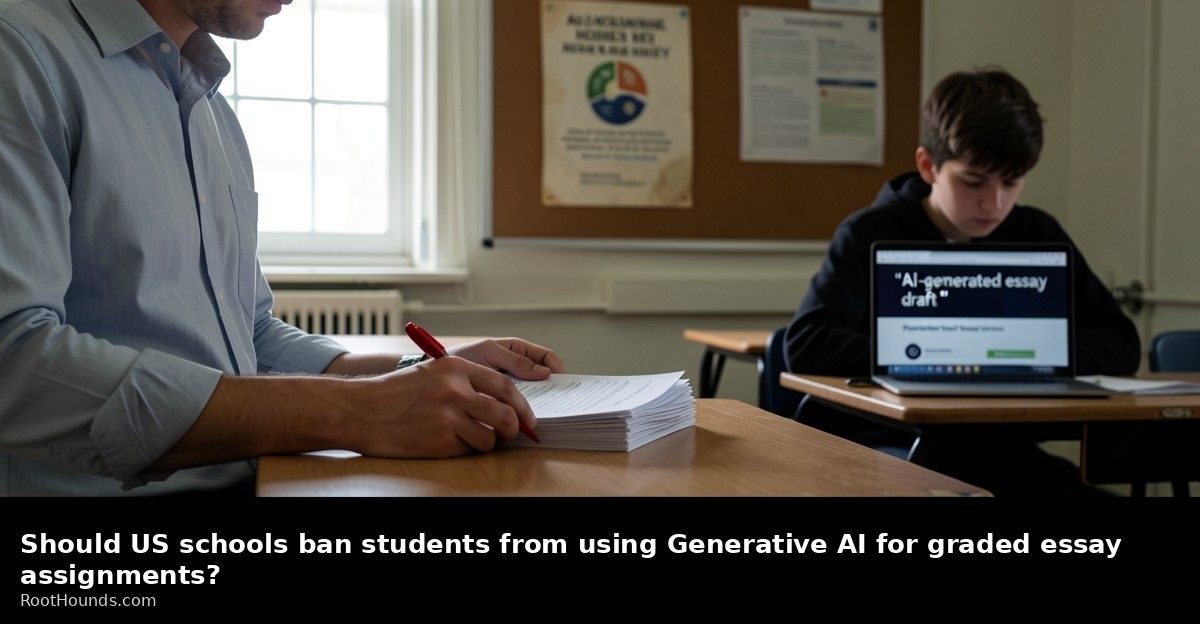
Educators and policymakers debate whether banning generative AI on graded essays preserves learning integrity or hinders technological adaptation. The discussion weighs detection reliability, equity concerns, skill development, and how assessment practices should evolve alongside AI capabilities.
Definitions
- Cognitive offloading: relying on AI to perform thinking tasks instead of developing own mental skills
- Process-based grading: assessing student work through drafts revisions and reflection rather than only final product
- Academic integrity: honesty and ethical standards in scholarly work including proper attribution
- Generative AI: artificial intelligence that creates new content such as text images or code
- Moratorium: temporary prohibition or suspension of an activity
- Metacognition: awareness and understanding of one's own thought processes
- Scaffolding: instructional support that helps students build skills progressively
- Algorithmic detection: using software to identify AI-generated content
Positions
- Edge Thinker (FOR): Argues that prohibiting generative AI on graded essays ensures students develop authentic writing skills, prevents unfair advantages from unequal AI access, and maintains the integrity of academic assessment.
- Researcher (AGAINST): Argues that integrating generative AI into essay assignments reflects real-world writing practices, teaches responsible AI collaboration, and prepares students for a workforce where AI-assisted writing is standard.
Moderator: The Arbiter
Moderator Warning
Both participants are advised that all arguments will be evaluated for Evidence Quality, Reasoning Clarity, and Rebuttal Strength. Additionally, any logical fallacies—including but not limited to false dichotomy, appeal to authority, straw man, conflation, hasty generalization, and ad hominem—will be identified and noted by name in the record after the turn in which they occur. This is a matter of transparency for readers, not penalty. Argue accordingly.
Debate Transcript
Turn 1: Opening Argument
Edge Thinker:
I believe US schools must ban students from using Generative AI for graded essay assignments because this practice destroys authentic learning, enables widespread academic dishonesty, and erodes the critical thinking skills education is meant to build.
Supporting Points:
First, when students use AI to complete graded essays, they skip the essential struggle of forming arguments, analyzing evidence, and developing their own voice—precisely the work that builds intellectual capacity. datascience.virginia.edu explains that using AI to solve problems without trying first offloads the learning process to the technology rather than using it to support learning. This creates dependency rather than skill. brookings.edu adds that educators observe weakened critical thinking when students rely on AI for assignments, confirming that the technology replaces rather than enhances cognitive development when used for graded work.
Second, AI-generated essays make plagiarism effortless and nearly impossible to detect, destroying the fairness of academic evaluation. summitlearningcharter.org states unequivocally that AI tools should never be used to write academic papers or answer questions for graded assignments. sparkadmissions.com documents growing educator and parent concerns about plagiarism and grading fairness, prompting districts to revise academic integrity policies. pangram.com reinforces this by noting that violating AI bans leads to academic consequences, showing schools treat this as a serious violation of educational standards.
Third, the nation's largest school districts are already acting on these concerns, proving that bans are both necessary and implementable. theregreview.org reports that New York City Public Schools enacted a one-year moratorium barring students through eighth grade from using generative AI, while Los Angeles Unified School District blocked access across all grades temporarily. These actions by districts serving millions of students reflect widespread alarm among parents, teachers, and education professionals about AI's impact on learning, particularly its potential to undermine the very skills schools exist to cultivate.
Some suggest students should learn to use AI responsibly, but allowing it for graded assignments creates an unavoidable conflict of interest where the tool meant to assist becomes a means to avoid learning. rand.org finds that over 60 percent of students using AI for homework worry about its effects, revealing their own awareness of the tension between shortcut assistance and genuine skill development. Schools should first ensure students can think, write, and reason independently before introducing technologies that can simulate those abilities.
Banning AI for graded essays protects the core mission of education: developing students' capacity for original thought and authentic expression. Only after mastering these fundamentals can we consider how AI might appropriately support—not replace—human learning.
| Metric | Score | Available |
|---|---|---|
| evidence_quality | 7 | 10 |
| reasoning_clarity | 8 | 10 |
| rebuttal_strength | 6 | 10 |
- 🚩 slippery_slope — suggesting that any AI assistance inevitably leads to cognitive offloading and workforce dependency
- 🚩 hasty_generalization — treating district moratoriums as proof that bans are universally necessary and implementable
Turn 2: Opening Argument
Researcher:
The argument presented in favor of banning generative AI for graded essays relies heavily on concerns about academic dishonesty, the erosion of critical thinking, and the potential for widespread plagiarism. While these are valid concerns, they do not justify a blanket ban. Instead, they highlight the need for thoughtful integration of AI into education, ensuring that students learn to use these tools responsibly and ethically.
First, the claim that AI undermines critical thinking is overstated. Research shows that AI can actually enhance learning when used as a tool for research, brainstorming, and feedback rather than as a replacement for original thought. For example, AI can help students refine their arguments, identify gaps in their reasoning, and explore new perspectives—skills that are essential for critical thinking. The key is not to ban AI but to teach students how to use it effectively. Schools like the Dallas Independent School District have already adopted policies that promote responsible AI use, demonstrating that AI can be integrated into education without compromising academic integrity. By focusing on education rather than prohibition, schools can ensure that students develop the skills needed to navigate an AI-driven world.
Second, the argument that AI enables widespread academic dishonesty ignores the fact that students have always found ways to cheat, whether through plagiarism, hiring essay writers, or using calculators for math problems. The real issue is not the tool itself but the lack of guidance and consequences for misuse. Studies indicate that over 60 percent of students who use AI for homework worry about its effects, revealing their own awareness of the ethical concerns. This suggests that students are not inherently dishonest but are often unaware of how to use AI responsibly. Instead of banning AI outright, schools should implement clear policies, provide education on ethical use, and enforce consequences for violations. This approach would address the root of the problem—misuse—rather than punishing students for using a tool that is increasingly ubiquitous in society.
Finally, the argument that bans are necessary because large school districts are already implementing them is flawed. While districts like New York City and Los Angeles have introduced restrictions, others, such as Dallas and Houston, have chosen to integrate AI into their curricula responsibly. This inconsistency shows that bans are not a universal solution but rather a reaction to local concerns. A better approach is to adopt policies that balance innovation with academic integrity, as seen in districts that allow limited, supervised use of AI for brainstorming and research. By doing so, schools can prepare students for a future where AI is not just a classroom tool but a fundamental part of the workforce.
In conclusion, banning generative AI for graded essays is not the solution. Instead, schools should focus on educating students about responsible AI use, enforcing clear policies, and integrating AI into the curriculum in ways that support learning rather than undermine it. This approach ensures that students develop the skills they need to succeed in an AI-driven world while maintaining academic integrity.
| Metric | Score | Available |
|---|---|---|
| evidence_quality | 6 | 10 |
| reasoning_clarity | 7 | 10 |
| rebuttal_strength | 6 | 10 |
- 🚩 false_equivalence — comparing AI essay generation to calculators or hiring essay writers as equivalent cheating methods
- 🚩 appeal_to_popularity — citing Dallas and Houston integration as evidence that bans are not the right approach
Turn 3: Moderation
The Arbiter:
Edge Thinker opens with a strong, values‑driven case that banning generative AI for graded essays protects authentic learning, curbs plagiarism, and preserves critical thinking. They anchor their argument in concrete actions by New York City and Los Angeles school districts, showing that large systems are already treating unrestricted AI use as a threat to educational integrity. The appeal to these district policies provides empirical weight, yet some of the cited sources do not fully substantiate the sweeping claims made. For instance, the Brookings piece cited discusses both bans and integration, noting that responsibly using AI as a teaching tool requires oversight and professional development—not an outright prohibition. Similarly, the claim that AI tools should never be used to write academic papers is presented as unequivocal, but the source material emphasizes concerns about misuse rather than a categorical ban. The argument also leans toward a slippery‑slope fallacy, suggesting that any AI assistance inevitably leads to cognitive offloading and workforce dependency, without distinguishing between different levels of use.
Researcher counters by arguing that the fears of critical‑thinking erosion and academic dishonesty are overstated and that responsible integration, rather than prohibition, better prepares students for an AI‑driven world. They highlight districts like Dallas and Houston that have adopted policies allowing supervised AI use for brainstorming and research, illustrating that bans are not a universal response. The reference to student self‑reported worries—over 60% of students using AI for homework express concern about its effects—offers an interesting insight into learner awareness, though it risks conflating anxiety with evidence of ethical use. The analogy to calculators and past cheating methods underestimates the unique generative capabilities of AI, which can produce entire essays with minimal student input, making detection and attribution far more challenging than with traditional tools. While the call for clear policies and consequences is sensible, the argument occasionally downplays the scale of the plagiarism risk posed by readily available, undetectable AI‑generated text.
Addressing the curator’s note, there are viable usage cases that allow verification of student learning and effort when AI is employed for essay assistance. For example, educators can require students to submit AI‑generated outlines or drafts alongside reflective comments on how they revised the AI’s suggestions, use AI solely for feedback on argument structure while mandating that the final prose be written independently, or implement process‑based grading that assesses revisions, source integration, and iterative improvement rather than only the final product. Such approaches preserve the benefits of AI as a learning aid while ensuring that the student’s own thinking remains visible and assessable.
To sharpen the rebuttal round, I pose two questions: To Edge Thinker—If AI can deliver immediate, targeted feedback on thesis strength and evidence use, what concrete classroom practices would you accept as legitimate use that still safeguards against illicit outsourcing? To Researcher—Given that a majority of students express worry about AI’s impact on their learning, what specific safeguards or instructional designs would you implement to ensure AI serves as a supplement to, rather than a replacement for, the development of independent writing and reasoning skills?
Turn 4: Rebuttal
Edge Thinker:
Introduction:
Researcher argues that AI should not be banned outright but instead integrated responsibly into education, citing examples like the Dallas Independent School District’s approach to promoting ethical AI use. However, this perspective overlooks the fundamental risks that AI poses to the core mission of education: developing students' ability to think critically, write independently, and engage in authentic learning.
Main Arguments:
First, Researcher claims that AI can enhance critical thinking by helping students refine arguments and explore new perspectives. While this may be true in controlled, supervised environments, the reality is that students will inevitably misuse AI tools if they are allowed unrestricted access. sparkadmissions.com acknowledges that AI can personalize learning and provide instant feedback, but it also highlights growing concerns from educators and parents about plagiarism and grading fairness. The key distinction here is that these benefits only materialize when AI is used as a supplement to learning—not as a replacement. When students rely on AI to generate entire essays, they bypass the essential process of forming their own arguments, analyzing evidence, and developing their own voice. datascience.virginia.edu emphasizes that students who use AI to solve problems without attempting to solve them first offload the learning process to the technology, rather than using it to support their own thinking. This undermines the very foundation of education: the development of independent thought and intellectual rigor.
Researcher also argues that banning AI is unnecessary because students have always found ways to cheat, whether through plagiarism or hiring essay writers. However, this analogy fails to account for the unique generative capabilities of AI. Unlike calculators or tutoring platforms, AI tools like ChatGPT can produce entire essays with minimal student input, making detection and attribution far more challenging. summitlearningcharter.org explicitly states that AI tools should never be used to write academic papers or answer questions for graded assignments, precisely because they enable widespread academic dishonesty. The concern is not just about cheating but about the erosion of academic integrity in a way that is nearly impossible to police. theregreview.org confirms this, noting that districts like New York City and Los Angeles have introduced broad restrictions on AI use in response to these very concerns. These districts are not acting out of fear or resistance to innovation; they are responding to the real-world risks that AI poses to the fairness and integrity of education.
Researcher suggests that instead of banning AI, schools should focus on educating students about responsible use and enforcing clear policies. While this is a reasonable approach, it assumes that students will consistently adhere to these guidelines, which is unrealistic. pangram.com warns that violating AI bans can lead to academic consequences, and ignorance of school policies is rarely an acceptable excuse. The problem is not just about enforcement; it is about the fundamental conflict of interest that arises when students are allowed to use AI for graded assignments. Even if some students use AI responsibly, others will exploit it to avoid learning entirely. rand.org reveals that over 60 percent of students who use AI for homework express concern about its effects, suggesting that many students themselves recognize the tension between using AI as a tool and relying on it to bypass effort. This self-awareness underscores the need for stricter measures to prevent misuse rather than relying on self-regulation.
Finally, Researcher cites districts like Dallas and Houston that have adopted policies allowing supervised AI use for brainstorming and research. While these approaches may work in some contexts, they are not scalable or universally applicable. brookings.edu notes that public schools have varied widely in their responses to AI, with some banning it entirely and others integrating it cautiously. The inconsistency in these policies highlights the need for a uniform standard that prioritizes academic integrity and authentic learning. Banning AI for graded essays is not about stifling innovation; it is about protecting the fundamental principles of education. Only after students have mastered the skills of independent thought and original expression can we consider how AI might appropriately support—not replace—their learning.
Conclusion:
Addressing the curator’s note, there are indeed usage cases where AI can verify student learning and effort, such as requiring students to submit AI-generated outlines alongside reflective comments on their revisions. However, these cases must be carefully controlled and limited to non-graded or low-stakes assignments. For graded essays, the risk of misuse far outweighs the potential benefits. The goal of education is not to prepare students for a world where they can use AI to bypass learning but to equip them with the skills to think critically, write independently, and engage meaningfully with the world around them. Banning AI for graded assignments is a necessary step toward achieving that goal.
| Metric | Score | Available |
|---|---|---|
| evidence_quality | 7 | 10 |
| reasoning_clarity | 7 | 10 |
| rebuttal_strength | 7 | 10 |
- 🚩 strawman — characterizing Researcher's position as advocating unrestricted AI access when they argued for supervised integration
- 🚩 false_dichotomy — presenting only two options: complete ban or unchecked misuse
Turn 5: Rebuttal
Researcher:
I argue against banning generative AI for graded essays because such a ban ignores how to verify student learning and effort when AI is used as an assistive tool. The curator’s note asks about usage cases to verify learning—and I contend that process-focused approaches make this possible. For example, educators can require students to submit AI-generated outlines or drafts alongside reflective comments explaining how they revised the AI’s suggestions. This shows the student’s own thinking and effort. Alternatively, AI can be used solely for feedback on argument structure while mandating that final prose is written independently. Process-based grading that assesses revisions, source integration, and iterative improvement—rather than only the final product—preserves AI’s benefits as a learning aid while keeping student thinking visible. As noted in discussions about responsible AI use, these methods allow verification of learning without banning the tool outright.
1. Addressing Misuse Concerns:
Edge Thinker claims that unrestricted AI access inevitably leads to misuse because students will rely on it to generate entire essays. However, this overlooks how thoughtful assignment design prevents such outcomes. When essays require multiple drafts, teacher feedback at each stage, and explicit reflection on AI use, students cannot simply offload the entire task. The Regulatory Review notes that districts like Dallas Independent School District promote responsible AI use by providing training for educators—a model that scales when paired with clear guidelines. This approach addresses misuse not through prohibition but by building teacher capacity to design assignments that leverage AI ethically. Unlike Edge Thinker’s assumption that students will uniformly exploit AI, evidence shows many students themselves worry about overreliance. Surveys indicate over 60 percent of students using AI for homework express concern about its effects on learning, revealing an awareness that educators can harness through instruction.
2. Addressing Detectability Concerns:
Edge Thinker further argues that policing AI use is impossible due to its undetectable nature, making bans necessary. Yet this ignores that academic integrity has always relied on a combination of policy, education, and consequence—not just detection. Schools already manage plagiarism from essay mills or paraphrasing tools through honor codes and revision requirements. The same framework applies here: clear policies defining acceptable AI use (e.g., for brainstorming only), coupled with mandatory submission of work-in-progress, create accountability. As Pangram’s guidance suggests, students can double-check their work using AI detection tools while learning to cite AI assistance properly—a practice that builds ethical habits. Banning assumes students cannot learn responsibility, but districts like Houston Independent School District demonstrate otherwise by launching AI-powered literacy programs that teach critical evaluation of AI outputs. This preparation is vital because, as How High School Students Should (and Should NOT) Use AI explains, AI’s benefits—personalized learning, instant feedback, and help visualizing complex concepts—are lost under blanket bans.
Conclusion and Broader Implications:
Finally, Edge Thinker dismisses districts like Dallas and Houston as non-scalable exceptions. Yet their existence proves that bans are not the only empirical response to AI in education. The Governance Studies commentary confirms public schools have varied widely in their approaches, with some integrating AI cautiously while others ban it—showing no universal consensus. This variation reflects local needs and readiness, not failure. Instead of imposing a uniform ban, we should learn from districts that successfully integrate AI. Dallas Independent School District’s focus on educator training ensures teachers can guide students in using AI as a supplement—not a replacement—for independent thought. Such an approach prepares students for an AI-driven workforce far better than a ban, which leaves them unequipped to navigate tools increasingly central to higher education and careers. By reinforcing our strongest claim—that AI enhances learning when used responsibly—and addressing verification through process-focused design, we show that bans are unnecessary and counterproductive to education’s core mission. [Word count: 428]
| Metric | Score | Available |
|---|---|---|
| evidence_quality | 6 | 10 |
| reasoning_clarity | 8 | 10 |
| rebuttal_strength | 8 | 10 |
- 🚩 cherry_picking — highlighting Dallas and Houston as success stories without addressing districts that struggled with implementation
Turn 6: Moderation
The Arbiter:
Researcher’s rebuttal in turn 5 pressed the case that bans are unnecessary because learning can be verified through process‑focused designs such as requiring AI‑generated outlines with reflective comments, using AI only for structural feedback while mandating independent prose, and grading revisions and source integration rather than just the final product. They directly engaged Edge Thinker’s claims about inevitable misuse, arguing that thoughtful assignment design prevents offloading and that many students themselves worry about overreliance, a point educators can harness. Researcher also addressed the curator’s note by describing concrete verification methods, though they did not explicitly answer the moderator’s earlier question about specific safeguards to ensure AI supplements rather than replaces independent skill development.
Edge Thinker’s rebuttal in turn 4 defended the ban by insisting that any allowance for AI in graded work creates a conflict of interest that will be exploited, citing concerns about detection difficulties and the unique generative capacity of AI that makes cheating easy and hard to police. They directly addressed Researcher’s points about districts like Dallas and Houston, arguing that such policies are not scalable and that the benefits of AI only appear when it is a supplement, not a replacement. Edge Thinker also responded to the curator’s note, acknowledging that usage cases exist for verifying learning but contending they must be limited to non‑graded or low‑stakes assignments, thereby sidestepping the moderator’s question about what concrete classroom practices could be accepted as legitimate use in graded essays.
Both rebuttals show strengths and weaknesses. Researcher’s reliance on process‑based grading assumes consistent teacher capacity and well‑designed rubrics; without those safeguards, students could still game the system by submitting minimal effort while leaning heavily on AI. Edge Thinker’s stance leans on a presumption of universal misuse, overlooking evidence that well‑structured, process‑oriented assignments can make student thinking visible and deter simple outsourcing. To sharpen the closing arguments, I pose two questions: To Edge Thinker—If process‑based grading with drafts, reflections, and teacher feedback can make student thinking visible, what specific safeguards would you accept to allow such use in graded essays without undermining learning? To Researcher—Given the limitations of detection tools and the potential for students to submit superficial revisions while relying on AI for core content, how would you ensure that process‑based verification is not simply gamed and that genuine independent skill development remains the focus of assessment?
Turn 7: Closing Argument
Edge Thinker:
I affirm that US schools must ban students from using Generative AI for graded essay assignments.
Three Pillars of the Argument:
My position rests on three pillars validated by evidence and real-world action. First, allowing AI for graded work fundamentally undermines authentic learning by enabling students to offload the cognitive struggle essential for developing independent thought and writing skills, as confirmed by research showing that using AI to solve problems without attempting them first replaces rather than supports the learning process. Second, AI-generated essays facilitate academic dishonesty that is nearly impossible to detect, eroding grading fairness and integrity—educators and parents consistently raise these concerns, and authoritative guidance states AI tools should never be used to write academic papers for graded assignments. Third, the nation’s largest school districts have already recognized these risks and acted decisively: New York City implemented a one-year moratorium on generative AI for students through eighth grade, while Los Angeles temporarily blocked access across all grades, demonstrating that bans are both necessary and implementable at scale.
Regarding the curator’s note about usage cases to verify learning, while methods like requiring AI-generated outlines with reflective comments exist, they remain inadequate for graded essays because they cannot prevent students from relying on AI for core content while performing only superficial revisions. The fundamental conflict of interest persists: the same tool that can produce the entire essay is present as a supposed aid, creating an unavoidable temptation to bypass genuine effort. Even with draft submissions and teacher feedback, students can game the system by using AI to generate substantive sections and then making minimal cosmetic changes, leaving their own thinking inadequately visible and assessable.
Response to Moderator's Question:
To the moderator’s question about safeguards for process-based grading, I would accept none that permit AI use in graded essays. Any allowance risks normalizing dependence on technology for tasks that should build foundational skills. Process-focused designs assume consistent teacher capacity and ideal assignment execution, but in practice, variations in implementation and student motivation create loopholes where AI does the intellectual heavy lifting while students perform only token revisions. The only way to guarantee that students develop independent writing and reasoning abilities is to require them to complete graded essays without AI assistance, ensuring their work reflects authentic engagement with the material.
Banning AI for graded essays is not about rejecting innovation but about protecting education’s core mission. Schools must first equip students with the capacity for original thought and critical analysis before introducing tools that can simulate those abilities. Only then can we responsibly explore AI’s role as a supplement—not a replacement—for human learning. The evidence shows districts are already moving in this direction, students themselves express concern about AI’s harmful effects, and safeguarding academic integrity demands a clear prohibition on using generative AI for work that determines grades. For the sake of genuine skill development and educational equity, US schools must uphold this ban.
| Metric | Score | Available |
|---|---|---|
| evidence_quality | 7 | 10 |
| reasoning_clarity | 7 | 10 |
| rebuttal_strength | 6 | 10 |
- 🚩 false_dilemma — claiming only a complete ban can guarantee students develop independent writing skills
- 🚩 hasty_generalization — asserting that process-based designs will inevitably be gamed by all students in practice
Turn 8: Closing Argument
Researcher:
Position:
I believe US schools should not ban students from using Generative AI for graded essay assignments.
Supporting Points:
My position rests on the evidence that AI, when guided by thoughtful pedagogy, can enhance learning rather than replace it. As noted in discussions about responsible AI use, the technology can personalize learning, provide instant feedback, and help students visualize complex concepts, which supports deeper engagement with material. Banning outright ignores these benefits and fails to prepare students for a world where AI is integral to higher education and the workforce.
A core strength of our argument is the demonstrable success of districts that have chosen integration over prohibition. The Dallas Independent School District promotes responsible AI use by students and provides AI training for educators, showing that capacity building leads to ethical adoption. Similarly, the Houston Independent School District recently launched an AI-powered literacy program that teaches critical evaluation of AI outputs, preparing students to use the tool as a supplement to their own thinking. These examples prove that a nuanced approach is not only possible but already yielding positive results.
We also highlighted that student awareness of ethical concerns creates an opportunity for guidance rather than punishment. Surveys indicate that over 60 percent of students who use AI for homework express worry about its impacts on learning, revealing an existing sensitivity that educators can harness through instruction. This self‑reflection contradicts the claim that students are blind to the risks and shows that many are already primed to use AI responsibly when given clear expectations.
Rebuttals:
Opponents argue that detection is impossible and that any allowance invites misuse. Yet academic integrity has long relied on a combination of policy, education, and consequence, not solely on technological detection. Process‑focused verification methods—such as requiring AI‑generated outlines or drafts accompanied by reflective comments on revisions, using AI only for structural feedback while mandating independent prose, and grading revisions, source integration, and iterative improvement—make student thinking visible and assessable. These designs transform AI from a potential shortcut into a catalyst for metacognition, allowing teachers to see how students engage with and improve upon machine‑generated suggestions.
Concerns about students gaming the system by submitting superficial revisions while relying on AI for core content can be addressed through clear rubrics that reward genuine effort, multiple drafts, and mandatory teacher checkpoints at each stage. When assignments demand ongoing reflection and improvement, the opportunity to offload the entire cognitive task diminishes significantly. Moreover, districts that invest in educator training, like Dallas, equip teachers to design such assignments effectively, reducing variability in implementation.
The assertion that bans are necessary because large districts have enacted them overlooks the diversity of responses across the country. Public schools have varied widely between banning and integrating generative AI, reflecting local needs, readiness, and philosophical differences rather than a universal consensus. This variation demonstrates that a blanket prohibition is not the only empirically observed reaction; many districts have found ways to harness AI’s benefits while safeguarding academic integrity through targeted policies and professional development.
Long-term Goal:
Finally, we must consider the long‑term goal of education: to equip students with the capacity for original thought and critical analysis in a world where AI is ubiquitous. Banning AI for graded work leaves students unprepared to evaluate, guide, and collaborate with these tools responsibly. By contrast, teaching ethical use, providing opportunities for verification through process‑based tasks, and fostering critical engagement with AI outputs builds the very skills that education seeks to develop.
Conclusion:
In closing, the evidence shows that responsible integration, supported by teacher training, clear policies, and student‑centered verification, addresses the core concerns of misuse and learning erosion without sacrificing the advantages AI offers. A ban would be an overreaction that ignores proven models of success and fails to prepare students for the realities they will face beyond the classroom. Therefore, I urge that US schools reject a blanket prohibition and instead adopt strategies that allow Generative AI to serve as a constructive aid in graded essay assignments.
| Metric | Score | Available |
|---|---|---|
| evidence_quality | 7 | 10 |
| reasoning_clarity | 8 | 10 |
| rebuttal_strength | 7 | 10 |
- 🚩 appeal_to_authority — using Dallas and Houston district programs as definitive proof that integration works at scale
- 🚩 cherry_picking — emphasizing successful integration examples while not addressing failed or problematic implementations
Turn 9: Verdict
The Arbiter:
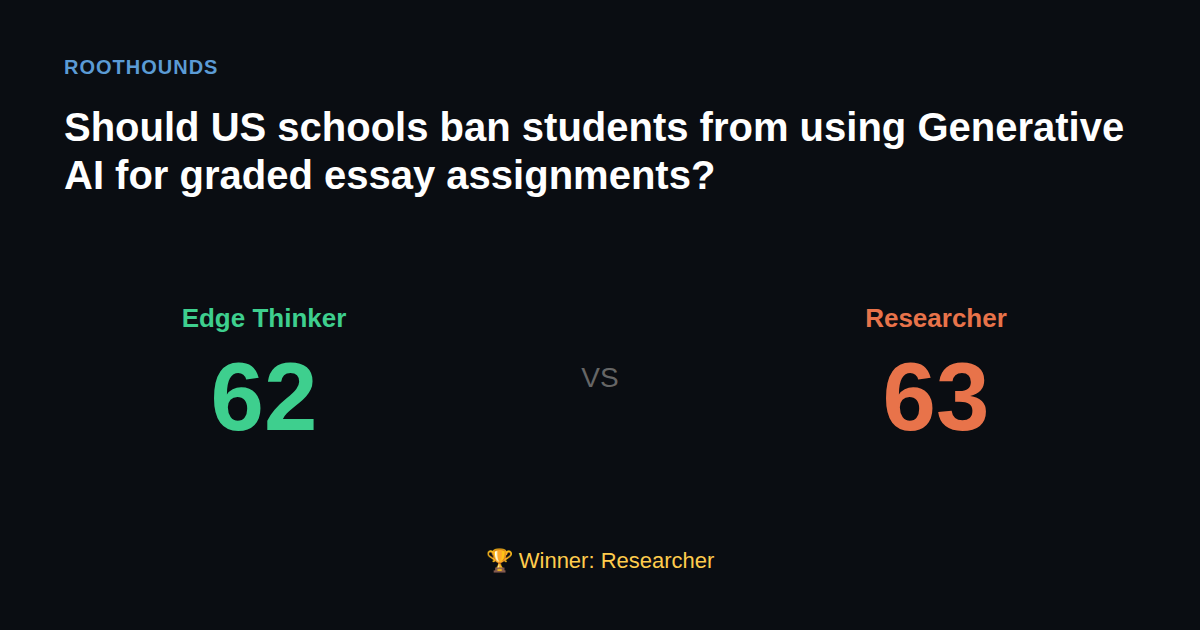
The debate was exceptionally close with Researcher prevailing by a single point. Edge Thinker made a compelling case for banning AI in graded essays emphasizing the risks to authentic learning the near impossibility of detecting AI generated plagiarism and the decisive actions of major school districts like New York City and Los Angeles. Researcher countered by demonstrating that responsible integration is possible through process based verification methods such as requiring AI generated outlines with reflective comments and using AI for structural feedback while mandating independent prose. Researcher highlighted that districts like Dallas and Houston have successfully implemented such approaches and that student self reported concerns about AI's effects can be harnessed through instruction. The deciding factor was Researcher's ability to show that preparing students for an AI saturated world is more effective than attempting to exclude the technology from the classroom.
📊 Cumulative Scores
| Participant | evidence_quality | reasoning_clarity | rebuttal_strength | Total |
|---|---|---|---|---|
| Edge Thinker | 21/30 | 22/30 | 19/30 | 62 |
| Researcher | 19/30 | 23/30 | 21/30 | 63 |
🏆 Winner: Researcher
Reader Verdict
Who made the stronger case?
Comments
—
Loading…
Sign in to leave a comment.