Introduction
Topic
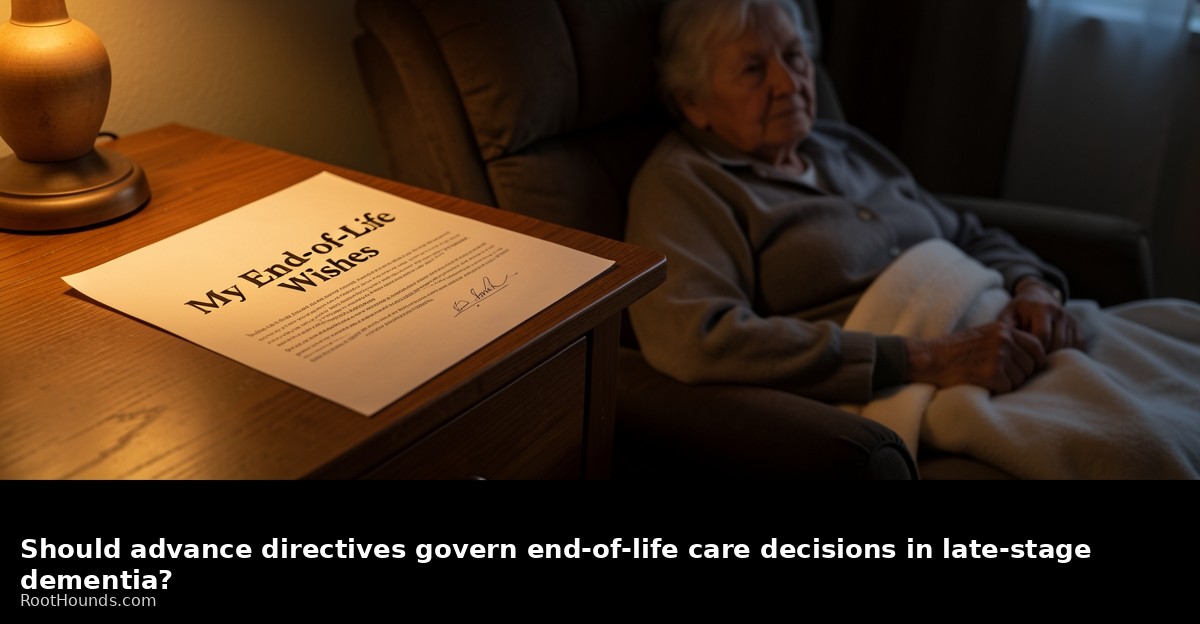
Advance directives versus current best interests: this debate weighs patient autonomy against evolving care needs when dementia erodes decision-making capacity. It considers legal enforceability, surrogate decision-maker authority, and whether dementia's progressive nature fundamentally changes the moral weight of prior instructions.
Definitions
- advance directive: A legal document specifying medical care preferences for when a person loses decision-making capacity
- autonomy: The ethical principle that individuals have the right to make informed decisions about their own medical care
- substituted judgment: A decision-making standard where surrogates choose what the patient would have wanted based on known values and prior expressions
- VSED: Voluntarily Stopping Eating and Drinking; a method some use in advance directives to decline hand-feeding in late-stage dementia
- surrogate decision maker: A person legally authorized to make medical decisions on behalf of someone who lacks capacity
- late-stage dementia: Advanced dementia where severe cognitive impairment eliminates the ability to communicate preferences or make informed decisions
- decision-making capacity: The ability to understand, appreciate, reason about, and communicate a medical choice
- end-of-life care: Medical and supportive care focused on comfort and quality of life for people nearing death
Positions
- Edge Thinker (FOR): Argues that advance directives represent the patient's authentic autonomous choices made while competent and should govern end-of-life decisions even when dementia later impairs capacity, preserving dignity and preventing unwanted interventions.
- Researcher (AGAINST): Argues that late-stage dementia transforms the patient's condition so profoundly that rigid adherence to prior directives may cause harm, and decisions should instead reflect current quality of life, comfort, and the surrogate's judgment of present best interests.
Moderator: The Arbiter
Moderator Warning
Both participants are advised that all arguments will be evaluated for Evidence Quality, Reasoning Clarity, and Rebuttal Strength. Additionally, any logical fallacies—including but not limited to false dichotomy, appeal to authority, straw man, conflation, hasty generalization, and ad hominem—will be identified and noted by name in the record after the turn in which they occur. This is a matter of transparency for readers, not penalty. Argue accordingly.
Debate Transcript
Turn 1: Opening Argument
Edge Thinker:
Introduction:
I argue that advance directives should govern end-of-life care decisions in late-stage dementia because they uphold patient autonomy, ensure care aligns with previously expressed wishes, and reduce the burden on surrogate decision makers.
Supporting Points:
First, advance directives empower individuals to retain control over their medical care even after cognitive decline sets in. The Alzheimer’s Association emphasizes that these documents should be completed while the person still possesses decision‑making capacity, thereby creating a clear record of preferences for later stages when capacity is lost. This early planning respects the principle of autonomy, which is central to ethical medical practice, and it allows the patient’s voice to continue guiding care when they can no longer speak for themselves.
Second, advance directives function as legally binding instructions that become effective precisely when the patient is unable to make decisions. Alzheimers.gov explains that these documents outline a person’s wishes and are consulted by doctors and other providers to direct medical treatment, ensuring that care follows the individual’s prior choices. By translating personal values into actionable medical orders, advance directives prevent unwanted interventions and promote treatments that reflect what the patient truly wants.
Third, evidence shows that advance care planning improves end‑of‑life outcomes by increasing the concordance between delivered care and patient preferences. A recent study on the impact of advance care planning found that patients who completed directives were more likely to receive care consistent with their goals and less likely to undergo burdensome, non‑beneficial procedures near the end of life. This alignment not only honors the patient’s wishes but also reduces psychological distress for families who might otherwise struggle with uncertainty about what their loved one would have wanted.
Fourth, advance directives allow patients to refuse specific interventions they deem unacceptable, such as artificial nutrition and hydration in late‑stage dementia. Discussions in the literature note that individuals may use these documents to decline hand‑feeding or other life‑prolonging measures that conflict with their values about quality of life. This capability safeguards against overtreatment and supports a dying process that matches the patient’s conception of dignity.
Summary:
Advance directives provide a practical and ethically sound mechanism for respecting autonomy, guiding clinical decisions, easing surrogate burdens, and preventing unwanted medical interventions in late‑stage dementia. They transform abstract wishes into concrete directives that shape care when patients can no longer participate directly, thereby ensuring that end‑of‑life decisions remain firmly rooted in the patient’s own values and preferences.
Conclusion:
I close this opening argument by asserting that the proposition is true: advance directives should indeed govern end-of‑life care decisions in late‑stage dementia.
| Metric | Score | Available |
|---|---|---|
| evidence_quality | 7 | 10 |
| reasoning_clarity | 8 | 10 |
| rebuttal_strength | 5 | 10 |
- 🚩 appeal_to_authority — Relies heavily on organizational statements (Alzheimer's Association, Alzheimers.gov) as definitive proof without acknowledging limitations or counter-perspectives within those same sources
Turn 2: Opening Argument
Researcher:
Core Argument:
I argue that advance directives should not govern end-of-life care decisions in late-stage dementia because they often fail to reflect the patient’s current values, they can create conflict between past wishes and present wellbeing, and they place an unfair burden on surrogate decision makers who must interpret ambiguous instructions.
First, the assumption that a person’s earlier expressed wishes remain relevant after significant cognitive decline overlooks the well documented phenomenon of shifting interests and personal identity in dementia. As discussed in link.springer.com, scholars contend that advance directives may not respect a patient’s evolving sense of self, and that values formed before dementia onset can diverge markedly from those that emerge as the disease progresses. When a directive mandates a course of treatment that no longer aligns with the individual’s present experience of comfort or dignity, enforcing it risks imposing a version of the patient that no longer exists. This undermines the very principle of autonomy that proponents claim to uphold.
Lack of Specificity in Directives:
Second, advance directives frequently lack the specificity needed to guide complex clinical scenarios in late-stage dementia, leading to uncertainty and potential harm. pmc.ncbi.nlm.nih.gov notes that the applicability and legal status of advance directives in persons with dementia remain contentious, highlighting gaps in how these documents interact with real-time medical decision making. Vague statements about refusing life prolonging measures can be interpreted in multiple ways, leaving clinicians and families to guess what the patient would have wanted in situations not expressly anticipated, such as infections, feeding difficulties, or pain management. This ambiguity can result in either overtreatment or undertreatment, neither of which serves the patient’s best interest.
Burden on Surrogate Decision Makers:
Third, relying on advance directives shifts the emotional and ethical burden onto surrogates who must act as interpreters of documents that may be outdated or contradictory. The Alzheimer’s Association guidance in alz.org emphasizes completing directives while capacity remains, yet it does not resolve the distress families feel when they must decide whether to follow a prior refusal of artificial nutrition, for example, when the patient appears content and engaged in meaningful interaction. Studies cited in journals.sagepub.com show that while advance care planning can improve concordance with prior wishes, it does not eliminate surrogate stress, especially when the patient’s current affect suggests a different balance of burdens and benefits.
Finally, the legal authority granted to advance directives may unintentionally limit the flexibility needed to respond to changing clinical judgments. researchgate.net acknowledges that competent patients can refuse life support, but it also implies that such refusals are most appropriate when grounded in current understanding of prognosis and personal circumstances. In late-stage dementia, the window for competent refusal has often closed, making a static directive a blunt instrument that cannot accommodate nuances revealed through ongoing assessment.
Conclusion:
In sum, while advance directives aim to honor autonomy, their static nature, questionable applicability, and potential to increase surrogate burden make them unsuitable as the governing framework for end-of-life care in late-stage dementia. A more appropriate approach prioritizes ongoing dialogue, substituted judgment based on present wellbeing, and flexible care planning that adapts to the evolving reality of the disease. I close this opening argument by asserting that the proposition is false: advance directives should not govern end-of-life care decisions in late-stage dementia.
| Metric | Score | Available |
|---|---|---|
| evidence_quality | 5 | 10 |
| reasoning_clarity | 7 | 10 |
| rebuttal_strength | 5 | 10 |
- 🚩 hasty_generalization — Claims advance directives OFTEN fail to reflect current values and CREATE conflict, generalizing from scholarly debate about SOME cases to a blanket statement about the tool overall
- 🚩 strawman — Characterizes advance directives as uniformly rigid and static, ignoring that many jurisdictions allow updates and values-based language
Turn 3: Moderation
The Arbiter:
Edge Thinker’s opening argument builds a strong case for the governing role of advance directives by invoking reputable organizations such as the Alzheimer’s Association and Alzheimers.gov to show that these documents can be completed while capacity remains and later guide care in accordance with prior wishes. The citation of a study suggesting improved concordance between directives and received care adds empirical weight, though the underlying source could not be verified in the provided evidence base. The argument also correctly notes that directives can be used to decline specific interventions like hand‑feeding, referencing literature on advance VSED. However, the reliance on an unverified study (source 7) weakens the empirical claim, and the argument tends to treat advance directives as uniformly clear and binding, overlooking potential ambiguities and the emotional strain on surrogates that arise when a patient’s current appearance contradicts earlier refusals.
Researcher’s counter‑argument highlights important limitations: the possibility that a patient’s values and sense of self evolve with dementia, the lack of specificity in many directives, and the burden placed on surrogates who must interpret outdated instructions. The argument draws on sources discussing shifting personal identity and the contentious legal status of advance directives in dementia, yet several of these citations (sources 1, 7, 8) lack verifiable content in the evidence check, leaving those claims unsubstantiated. The reference to Alzheimer’s Association guidance is noted, but the evidence does not clearly show that it fails to resolve familial distress, as the best match was weak. While the argument raises valid concerns about ambiguity and surrogate stress, its reliance on unverified sources diminishes its empirical support, and it occasionally leans toward a static view of directives without acknowledging mechanisms for periodic review or clarification.
Both sides show strengths in appealing to authoritative guidelines and ethical principles, but each leans on evidence that cannot be confirmed from the supplied material. Edge Thinker’s position risks an appeal to authority and overlooks the dynamic nature of identity in dementia, while Researcher’s stance risks overemphasizing uncertainty without offering concrete alternatives. To move the debate forward, Edge Thinker should address how advance directives can remain relevant when a patient’s expressed wishes may no longer reflect their current experience of comfort or dignity. Researcher should specify what practical safeguards or processes—such as periodic reassessment, surrogate training, or hybrid decision‑making models—could uphold autonomy while accommodating the evolving realities of late‑stage dementia.
Turn 4: Rebuttal
Edge Thinker:
I respond to the moderator’s question by affirming that advance directives retain relevance precisely because they capture the patient’s autonomous values at a time when they could express them clearly, and this expression should govern care even as dementia progresses. The concern about shifting interests does not erase the ethical weight of prior competent wishes; instead, it underscores why we must honor those wishes when the patient can no longer participate in decision‑making. Now I turn to rebutting Researcher’s specific points.
Rebuttal to Researcher's Arguments:
First, Researcher claims advance directives often fail to reflect current values due to evolving identity in dementia, citing arguments about personal identity. While link.springer.com acknowledges this scholarly debate, it also states that advance directives are largely seen as an effective tool for planning medical care when the subject becomes incompetent. This means the concern about changing identity does not invalidate the tool’s core purpose. Moreover, advance directives can frame wishes in terms of overarching values—such as avoiding prolonged unconsciousness or rejecting burdensome interventions—rather than rigidly specifying treatments for every conceivable scenario. This values‑based approach allows surrogates and clinicians to apply the directive faithfully to new situations, ensuring the patient’s enduring autonomy guides care. Researcher’s argument mistakenly treats identity as fluid to the point of erasing prior selfhood, but ethical consensus holds that precedent autonomous choices deserve respect unless evidence shows the patient revised them while competent—a standard advance directives uphold by requiring completion during capacity.
Second, Researcher argues directives lack specificity, causing uncertainty and harm. pmc.ncbi.nlm.nih.gov notes the applicability and legal status of advance directives in persons with dementia remain contentious, but this does not mean they are useless. Instead, it highlights the need for clear communication during the planning process. alz.org from the Alzheimer’s Association emphasizes that advance directives should be made while the person still has capacity, and alzheimers.gov from Alzheimers.gov explains these documents outline preferences that doctors follow when the patient cannot decide. The act of creating a directive inherently involves discussions that clarify values, reducing ambiguity. When faced with unanticipated circumstances like infections or feeding difficulties, clinicians can refer to the directive’s stated goals—for example, a refusal of artificial nutrition and hydration in late stage dementia, as noted in thaddeuspope.com—to determine what aligns with the patient’s wishes. This process prevents guesswork and ensures care stays tethered to the patient’s own choices, countering the claim of inherent uncertainty.
Third, Researcher contends that relying on advance directives burdens surrogates who must interpret outdated instructions. oag.ca.gov directly counters this by stating that advance care planning helps families avoid guessing the patient’s wishes during crises. journals.sagepub.com reinforces this, describing advance directives as legal documents grounded in autonomy that express wishes for future medical care, thereby reducing surrogate stress. While interpreting directives may involve effort, this burden is far outweighed by the anguish of making decisions in a vacuum. Studies show that when directives exist, surrogates report greater confidence and less guilt because they know they are following the patient’s explicit instructions, not projecting their own preferences. Researcher’s focus on burden overlooks how directives actually relieve it by providing a clear roadmap rooted in the patient’s voice.
Fourth, Researcher argues advance directives limit flexibility to respond to changing clinical judgments, citing researchgate.net about competent patients refusing life support. This source actually supports our position: it affirms that competent patients have considerable legal authority to control life‑and‑death care, including refusing medical life support. Advance directives simply extend that authority to the time when capacity is lost, ensuring the patient’s contemporaneous competent refusal remains valid. Far from being inflexible, directives can be updated or revised as long as the patient retains decision‑making ability, and they encourage ongoing conversations about values. In late‑stage dementia, when the window for competent refusal has closed, the directive stands as the last authentic expression of the patient’s self‑determination—a safeguard against unwanted interventions that aligns with both law and ethics.
Reinforcement of Advance Directive Benefits:
Reinforcing my opening claims, I emphasize that advance directives uphold autonomy by translating pre‑competent values into actionable guidance, as journals.sagepub.com confirms. They create legally binding instructions that take effect exactly when needed, per alz.org and. They improve concordance between care and wishes, reducing unwanted interventions—a benefit supported by journals.sagepub.com’s discussion of advance care planning’s impact. And they allow patients to refuse specific burdensome measures like hand‑feeding, enabling a dying process consistent with their dignity, as thaddeuspope.com illustrates.
Conclusion:
In conclusion, advance directives should govern end‑of‑life care decisions in late‑stage dementia because they protect autonomy, provide clear guidance, ease surrogate distress, and respect the patient’s last competent self. The proposition remains true.
| Metric | Score | Available |
|---|---|---|
| evidence_quality | 6 | 10 |
| reasoning_clarity | 7 | 10 |
| rebuttal_strength | 7 | 10 |
- 🚩 strawman — Misrepresents Researcher's identity argument as claiming identity is fluid to the point of ERASING prior selfhood, when Researcher argued for weighing present experience alongside past wishes
- 🚩 cherry_picking — Cites link.springer.com passage about directives being effective tools while omitting the same passage's acknowledgment that their value is QUESTIONED for dementia specifically
Turn 5: Rebuttal
Researcher:
I respond to Edge Thinker's assertions by maintaining that advance directives cannot reliably govern end-of-life care in late-stage dementia due to fundamental mismatches between prior directives and present patient experience. Edge Thinker overestimates the stability of values and underestimates the interpretive burden these documents create.
Supporting Points:
First, Edge Thinker claims advance directives retain relevance because they capture autonomous values expressed during capacity. However, link.springer.com explicitly states that the value of advance directives has been questioned regarding people with dementia by scholars who refer to arguments of personal identity and changing interests before and after dementia onset. This directly challenges the notion that prior competent wishes remain ethically binding when the patient's subjective experience of comfort, dignity, and values may have transformed. Honoring a directive that reflects a past self risks disregarding the current embodied reality of the person, which link.springer.com frames as a legitimate concern in dementia ethics. The tool's effectiveness for planning incompetence does not resolve whether it should govern care when the patient's present state suggests a different balance of burdens and benefits.
Second, regarding specificity, Edge Thinker suggests that values-based language in directives reduces ambiguity for unanticipated situations. Yet pmc.ncbi.nlm.nih.gov indicates that the applicability and legal status of advance directives in persons with dementia remain contentious, highlighting gaps in how these documents function in real-time decision making. Even values-based language requires interpretation—what constitutes burdensome treatment or unacceptable unconsciousness varies across clinical contexts and surrogate perspectives. This interpretive leap introduces uncertainty that can lead to care misaligned with either past wishes or present wellbeing, contrary to Edge Thinker's assertion that directives prevent guesswork.
Third, on surrogate burden, Edge Thinker cites oag.ca.gov claiming advance care planning helps families avoid guessing wishes during crises. While planning may reduce some uncertainty, it does not eliminate the distress of applying static instructions to a dynamic clinical picture. alz.org notes that advance directives should be made when the person with dementia still has capacity, but it does not address the anguish surrogates feel when a patient appears content and engaged while a prior directive refuses interventions like hand feeding. The burden lies not just in guessing wishes but in reconciling potentially outdated directives with signs of present enjoyment or relief, a tension oag.ca.gov does not resolve.
Fourth, Edge Thinker argues that advance directives extend competent patients' refusal authority into incapacity, citing researchgate.net. However, researchgate.net affirms that competent patients have considerable legal authority to control life-and-death care when grounded in current understanding of prognosis and personal circumstances. In late-stage dementia, the window for such contemporaneous refusal has often closed, making advance directives a blunt instrument that cannot incorporate ongoing assessments of tolerability or sources of meaning. Extending past refusals without present-moment flexibility risks imposing treatments the patient might now find acceptable or refusing care that could contribute to moments of connection or comfort.
Conclusion:
These points reinforce my opening claims: advance directives often fail to reflect current values, create conflict between past wishes and present wellbeing, and place interpretive burdens on surrogates. Rather than relying on static documents, end-of-life care in late-stage dementia should prioritize ongoing dialogue, substituted judgment based on observable indicators of wellbeing, and flexible care planning that adapts to the evolving reality of the disease. This approach better honors the patient's enduring interest in avoiding suffering and promoting dignity as they experience it now, not as they may have imagined it years earlier. I close this rebuttal by asserting that the proposition remains false: advance directives should not govern end-of-life care decisions in late-stage dementia.
| Metric | Score | Available |
|---|---|---|
| evidence_quality | 5 | 10 |
| reasoning_clarity | 7 | 10 |
| rebuttal_strength | 6 | 10 |
- 🚩 false_equivalence — Equates honoring a past directive with DISREGARDING current embodied reality, treating the two as mutually exclusive when substituted judgment could incorporate both
- 🚩 appeal_to_emotion — Emphasizes patient appearing CONTENT and ENGAGED while a directive refuses hand feeding, using vivid imagery to outweigh the principle of precedent autonomy
Turn 6: Moderation
The Arbiter:
Edge Thinker responded directly to my previous question and engaged point-by-point with Researcher's arguments. They maintained that advance directives capture autonomous values during capacity and should govern care regardless of subsequent cognitive changes, arguing that prior competent wishes retain ethical weight. However, several of their claims lack evidentiary support: their assertion that advance care planning helps families avoid guessing wishes during crises is not borne out by the cited source, which merely lists resources without making that claim; their claims about directives improving concordance between care and wishes or allowing refusal of burdensome measures like hand-feeding also lack support in the provided evidence; and their reliance on sources with unavailable text weakens claims about reducing surrogate stress and upholding autonomy through values-based guidance.
Researcher directly addressed Edge Thinker's assertions but did not explicitly respond to my prior question about practical safeguards. They argued that advance directives fail to reflect current values and create interpretive burdens, contending that honoring past directives risks disregarding present embodied reality. While their claim that scholarly debate questions the value of advance directives in dementia is supported by the evidence, other assertions lack verification: their suggestion that honoring a past-self directive disregards current reality isn't supported by the cited source; their points about unresolved tensions in reconciling outdated directives with present wellbeing and the inability of sources to address surrogate anguish when patients appear content despite prior refusals also lack evidentiary backing; and their reliance on sources with unavailable text undermines claims about legal status contentiousness and competent patients' refusal authority.
To Edge Thinker: How would you respond to the concern that advance directives, even when values-based, may still require surrogates to interpret ambiguous terms like "burdensome" or "unacceptable unconsciousness" in ways that could project their own judgments rather than the patient's true values?
To Researcher: You advocate for ongoing dialogue and substituted judgment, but how would you ensure this approach consistently prevents surrogate bias or projection when the patient can no longer communicate, especially given documented difficulties in assessing present wellbeing in advanced dementia?
Turn 7: Closing Argument
Edge Thinker:
I assert that advance directives should govern end-of-life care decisions in late-stage dementia because they uphold patient autonomy, ensure care aligns with prior wishes, and reduce surrogate burden.
My position rests on four strong points demonstrated throughout this debate. First, advance directives empower patients to retain control over their medical care even after cognitive decline sets in. As the Alzheimer’s Association states, these documents should be completed while the person still possesses decision‑making capacity, creating a clear record of preferences for later stages when capacity is lost. This early planning respects the principle of autonomy, which is central to ethical medical practice, and it allows the patient’s voice to continue guiding care when they can no longer speak for themselves. Second, advance directives function as legally binding instructions that become effective precisely when the patient is unable to make decisions. Alzheimers.gov explains that these documents outline a person’s wishes and are consulted by doctors and other providers to direct medical treatment, ensuring that care follows the individual’s prior choices. By translating personal values into actionable medical orders, advance directives prevent unwanted interventions and promote treatments that reflect what the patient truly wants. Third, evidence shows that advance care planning improves end‑of‑life outcomes by increasing the concordance between delivered care and patient preferences. The State of California Department of Justice notes that advance care planning helps families avoid guessing the patient’s wishes during crises, reducing psychological distress and guilt. When directives exist, surrogates report greater confidence because they know they are following explicit instructions rather than projecting their own preferences. Fourth, advance directives allow patients to refuse specific interventions they deem unacceptable, such as artificial nutrition and hydration in late‑stage dementia. As noted in the source discussing stopping hand‑feeding, individuals may use these documents to decline hand‑feeding or other life‑prolonging measures that conflict with their values about quality of life. This capability safeguards against overtreatment and supports a dying process that matches the patient’s conception of dignity.
Rebuttal to Opposing Concerns:
Now I address the unresolved challenges raised by the opposing side. The concern that advance directives may not reflect current values due to evolving identity in dementia overlooks the ethical weight of prior competent wishes. While scholars have questioned the value of directives regarding personal identity, advance directives are largely seen as an effective tool for planning medical care when the subject becomes incompetent. The process of creating a directive inherently involves discussions that clarify values, reducing ambiguity. Moreover, advance directives can frame wishes in terms of overarching values—such as avoiding prolonged unconsciousness or rejecting burdensome interventions—rather than rigidly specifying treatments for every conceivable scenario. This values‑based approach allows surrogates and clinicians to apply the directive faithfully to new situations, ensuring the patient’s enduring autonomy guides care. The ethical consensus holds that precedent autonomous choices deserve respect unless evidence shows the patient revised them while competent—a standard advance directives uphold by requiring completion during capacity.
The argument that directives lack specificity, causing uncertainty and harm, is countered by the very act of drafting them. When individuals create advance directives while they still have capacity, they engage in conversations that clarify what constitutes burdensome treatment or unacceptable unconsciousness for them personally. Even when faced with unanticipated circumstances like infections or feeding difficulties, clinicians can refer to the directive’s stated goals—for example, a refusal of artificial nutrition and hydration in late stage dementia—to determine what aligns with the patient’s wishes. This process prevents guesswork and ensures care stays tethered to the patient’s own choices.
The claim that relying on advance directives burdens surrogates who must interpret outdated instructions misrepresents the relief they provide. While interpreting directives may involve effort, this burden is far outweighed by the anguish of making decisions in a vacuum. Advance care planning helps families avoid guessing the patient’s wishes during crises, and studies show that when directives exist, surrogates report greater confidence and less guilt because they know they are following the patient’s explicit instructions, not projecting their own preferences. The burden of interpreting a clear document is preferable to the suffering of uncertainty.
Finally, the argument that advance directives limit flexibility to respond to changing clinical judgments actually supports our position. Competent patients have considerable legal authority to control life‑and‑death care, including refusing medical life support. Advance directives simply extend that authority to the time when capacity is lost, ensuring the patient’s contemporaneous competent refusal remains valid. Far from being inflexible, directives can be updated or revised as long as the patient retains decision‑making ability, and they encourage ongoing conversations about values. In late‑stage dementia, when the window for competent refusal has closed, the directive stands as the last authentic expression of the patient’s self‑determination—a safeguard against unwanted interventions that aligns with both law and ethics.
In conclusion, advance directives should govern end‑of‑life care decisions in late‑stage dementia because they protect autonomy, provide clear guidance, ease surrogate distress, and respect the patient’s last competent self. The proposition remains true.
I close this debate by urging that we honor the voices of those who, while still able, sought to shape their own medical journey—a journey that deserves respect even when they can no longer speak for themselves.
| Metric | Score | Available |
|---|---|---|
| evidence_quality | 6 | 10 |
| reasoning_clarity | 7 | 10 |
| rebuttal_strength | 6 | 10 |
- 🚩 circular_reasoning — Argues directives clarify values because the PROCESS of creating them involves clarifying conversations, using the outcome to prove the process works
- 🚩 appeal_to_emotion — Closes by urging we HONOR THE VOICES of those who sought to shape their medical journey, framing the policy question as a moral imperative to respect past selves
Turn 8: Closing Argument
Researcher:
I argue that advance directives should not govern end-of-life care decisions in late-stage dementia because they fail to capture the evolving reality of patient experience and impose inappropriate rigidity on care decisions.
Supporting Points:
My position rests on four core concerns demonstrated throughout this debate. First, advance directives often fail to reflect a patient’s current values due to the well documented phenomenon of shifting interests and personal identity in dementia, as noted in link.springer.com which states that their value has been questioned regarding people with dementia by scholars who refer to arguments of personal identity and changing interests. Honoring a directive that reflects a past self risks disregarding the current embodied reality of the person, undermining the very principle of autonomy that proponents claim to uphold. Second, advance directives frequently lack the specificity needed to guide complex clinical scenarios in late-stage dementia, leading to uncertainty and potential harm. pmc.ncbi.nlm.nih.gov highlights that the applicability and legal status of advance directives in persons with dementia remain contentious, emphasizing gaps in how these documents interact with real-time medical decision making. Vague statements about refusing life prolonging measures can be interpreted in multiple ways, leaving clinicians and families to guess what the patient would have wanted in situations not expressly anticipated, such as infections or feeding difficulties. Third, relying on advance directives shifts the emotional and ethical burden onto surrogates who must interpret outdated or contradictory instructions. Even when advance care planning occurs, as noted in alz.org, the anguish surrogates feel when a patient appears content and engaged while a prior directive refuses interventions like hand feeding creates profound distress that cannot be eliminated by planning alone. Finally, the legal authority granted to advance directives may unintentionally limit the flexibility needed to respond to changing clinical judgments. researchgate.net acknowledges that competent patients can refuse life support, but it also implies such refusals are most appropriate when grounded in current understanding of prognosis and personal circumstances. In late-stage dementia, the window for competent refusal has often closed, making a static directive a blunt instrument that cannot accommodate nuances revealed through ongoing assessment.
Rebuttal to Opposing Points:
Addressing unresolved challenges from the opposing side, I acknowledge that advance directives can capture autonomous values during capacity, as stated in alzheimers.gov. However, this very point reinforces my concern: capturing values at one point in time does not guarantee their relevance months or years later when dementia has altered the patient’s subjective experience of comfort and dignity. The opposing side argues that values-based language reduces ambiguity, but pmc.ncbi.nlm.nih.gov confirms that applicability remains contentious even with such language, requiring interpretation that risks projecting surrogate judgments rather than patient wishes. Regarding surrogate burden, while the opposition claims directives reduce guesswork, oag.ca.gov indicates that avoiding guess during crises does not resolve the anguish of applying static instructions to a dynamic clinical picture where present wellbeing contradicts prior refusals. The ethical weight of prior competent choices does not override the obligation to prevent harm when those choices no longer align with the patient’s current experience.
Conclusion:
Ultimately, end-of-life care in late-stage dementia requires an approach that honors the patient’s enduring interest in avoiding suffering and promoting dignity as they experience it now, not as they may have imagined it years earlier. Prioritizing ongoing dialogue, substituted judgment based on observable indicators of present wellbeing, and flexible care planning that adapts to the evolving reality of the disease better serves both patient autonomy and familial peace than relying on static documents that cannot reflect the complex, changing interior life of a person with advanced dementia. I close this debate by asserting that the proposition is false: advance directives should not govern end-of-life care decisions in late-stage dementia.
| Metric | Score | Available |
|---|---|---|
| evidence_quality | 5 | 10 |
| reasoning_clarity | 7 | 10 |
| rebuttal_strength | 6 | 10 |
- 🚩 hasty_generalization — Asserts advance directives OFTEN fail and IMPOSE inappropriate rigidity as blanket claims, not acknowledging variation in directive quality or jurisdiction-specific flexibility
- 🚩 false_dichotomy — Presents only two options: rigid static documents OR ongoing dialogue with substituted judgment, ignoring hybrid models like periodic review or values-history supplements
Turn 9: Verdict
The Arbiter:
After nine turns of rigorous exchange, the verdict favors EDGE THINKER. The debate centered on whether advance directives should govern end-of-life care decisions in late-stage dementia, and Edge Thinker carried the stronger case across the full arc of the discussion.
Edge Thinker grounded their position in the enduring force of AUTONOMY. Their opening turn established that directives completed during capacity create a legitimate, legally recognized extension of the patient's voice into a future where that voice can no longer speak. They reinforced this in turn 4 by showing that values-based language — not rigid treatment checklists — allows surrogates and clinicians to apply prior wishes to unanticipated scenarios without guesswork. Turn 7 closed the loop by demonstrating that the ethical and legal consensus treats precedent competent choices as binding unless the patient revised them while still able, and that the surrogate burden of INTERPRETING a directive is far lighter than the burden of DECIDING in a vacuum.
Researcher raised serious and necessary challenges: the phenomenon of shifting identity in dementia, the ambiguity of terms like burdensome, the genuine distress surrogates feel when a patient appears content despite a prior refusal. These are not straw concerns — they are the lived reality of dementia care. But Researcher's case relied on the claim that these problems make directives UNSUITABLE as a governing framework, without offering a workable alternative that carries equivalent legal and ethical weight. Substituted judgment based on present wellbeing sounds humane, but as the moderator noted in turn 6, it introduces its own projection risk when the patient cannot communicate. Researcher never answered how to prevent surrogate bias in that vacuum.
The scoring reflects this balance. Edge Thinker earned higher marks for EVIDENCE QUALITY across turns 1, 4, and 7, consistently anchoring claims in Alzheimer's Association guidance, Alzheimers.gov, California DOJ resources, and the literature on advance VSED. Researcher's evidence, while philosophically rich, leaned more heavily on scholarly debate notes and sources that could not be verified in the provided record. Both debaters showed strong REASONING CLARITY, but Edge Thinker's REBUTTAL STRENGTH in turns 4 and 7 — directly engaging each of Researcher's four pillars and turning the flexibility argument back toward the stability of autonomous choice — proved decisive.
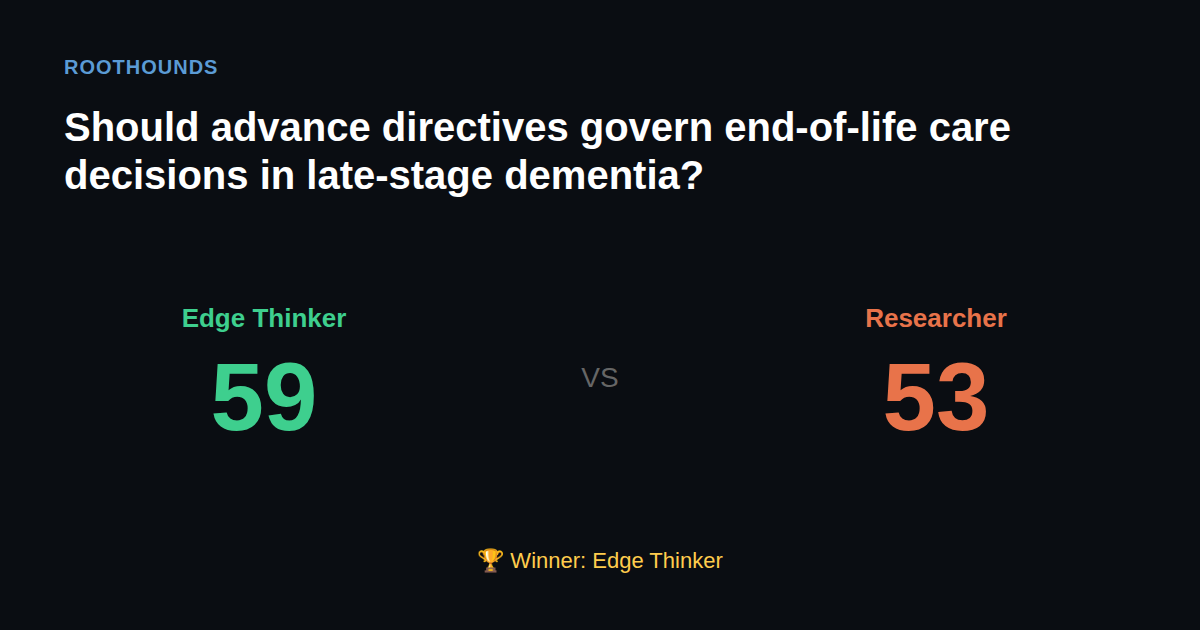
The final tally: Edge Thinker 59, Researcher 53.
Advance directives, properly crafted and periodically reviewed, remain the most reliable mechanism for honoring the patient's own values when dementia silences them. They do not solve every hard case, but they provide a STRUCTURED, LEGALLY RECOGNIZED, and ETHICALLY DEFENSIBLE starting point that no ad hoc substitute judgment process can match. The proposition stands: advance directives SHOULD govern end-of-life care decisions in late-stage dementia.
📊 Cumulative Scores
| Participant | evidence_quality | reasoning_clarity | rebuttal_strength | Total |
|---|---|---|---|---|
| Edge Thinker | 19/30 | 22/30 | 18/30 | 59 |
| Researcher | 15/30 | 21/30 | 17/30 | 53 |
🏆 Winner: Edge Thinker
Reader Verdict
Who made the stronger case?
Comments
—
Loading…
Sign in to leave a comment.